There are dishes that comfort you. There are dishes that impress you. And there dishes that challenge you: that make you pause before the first bite, and then...immediately reach for a second. Pajata is exactly that kind of dish.
Pajata: The Most Controversial Roman Dish
Published on

It's not for everyone, and Romans will be the first to tell you so. But for those who dare to try it, pajata is often described as one of the most memorable, deeply authentic things they've ever eaten in their lives.
If you come to Rome looking for something real, something far beyond the tourist menus plastered outside every piazza restaurant, you just found it.
What Is Pajata? Meaning and Definition
Before we talk about flavor, we need to talk about honesty. Because Pajata is the kind of dish that deserves a straightforward introduction, not a PR makeover.
Pajata (sometimes spelled pagliata) refers to the small intestine of an unweaned milk-fed calf (specifically, an animal that has not yet been weaned from its mother's milk). What makes it unique - and, admittedly, what makes some people raise an eyebrow - is that the intestines are cooked with the chyme still inside: a thick, creamy, milk-like substance that, during cooking, coagulates into something almost ricotta-like in texture.
The result is a rich, deeply, sacovry filling encased in tender meat, braised slowly in tomato sauce until everything melts together into one of the most unctuous, velvety pasta sauces you'll ever encounter. Pajata is the heart of what Roman call quinto quarto: literally "the fifth quarter" of the animal. The idea is this: a butchered cow has four quarters (the prime cuts). Everything else - offal, organ meats, intestines, tripe - become the fifth quarter.
In working-class Rome, the quinto quarto was a survival trend. And out of that survival came some of the greatest dishes in the city's history.
Pajata Pronunciation
Quick stop before we go furhter, because you're going to want to say this word out loud at a trattoria and actually sound like you know what you're ordering.
Pjata is pronounced pa-YAH-ta. The stress lands firmly on the second syllabe, the "j" is soft (almost like a "y" sound in Italian), and the final "a" is clean and open. Say it with confidence. Romans appreciate nothing more than a foreigner who takes their food seriously enough to get the name right.
The History of Payata in Roman Cuisine
Every great Roman dish has a story rooted in the streets, not the palace kitchens: and pajata is no exception.
To understand pajata, you need to understand Testaccio, the old slaughterhouse district of Rome. For centuries, the Mattatoio di Testaccio, one of the largest slaughterhouses in Europe, was the beating, bloody heart of the city's meat trade. The workers there, known as vaccinari, were often paid not in chas but in kind: they received the cuts of meat that the wealthy classes didn't want. The prime cuts went to the nobility, the restaurants, the butcher shops of the bourgeoisie. What was left - the heads, the tails, the organs, the intestines - went to the workers.
Those workers brought that fifth quarter home to their families, and Roman women - le nonne di Testaccio - did what Italian grandmothers have always done: they turned nothing into something extraordinary. Slow cooking. Patience. An intuitive knowledge of spice and technique that no culinary school has ever truly been able to replicate. The quinto quarto tradition was born in that neighborhood, and it produced dishes like pajata, coda alla vaccinara (oxtail stew), trippa alla romana (tripe with tomato and mint), and rigatoni con la pajata that are now considered the cornerstones of authentic Roman cuisine.
For decades, pajata sat proudly on trattoria menus across Testaccio and beyond. Then came a major disruption: in the late 1980s and 1990s, in the wake of the BSE crisis (commonly known as mad cow disease), European health regulations banned the sale and consumption of intestines from bovines under twelve months of age. For years, authentic pajata was almost impossible to find legally in Italy. Restaurants served substitutes. The dish became kind of culinary ghost present in collective memory, but absent from tables.
The ban was eventually lifted in Italy in 2015, when strict sourcing and veterinary controls were put in place. Pajata came back. And Roman celebrated like it was homecoming.
Where Is Pajata Most Commonly Eaten?
Pajata is, first and foremost, a Roman dish, and it rarely travels beyond the city's limits.
You'll find it in Rome and the broader Lazio region, served in the kind of trattorias that have checkered tablecloths, handwritten menus, an a nonno somewhere in the back who's been making the same sauce for forty years. Testaccio remains the spiritual home of pajata, but you'll also find it in Trastevere, Prati and Pigneto, neighborhoods where Roman culinary tradition is still alive and unaplogetic.
Pne piece of advice: if you see pajata on a laminated menu fifty meters from the Colosseum, keep walking. The real thing is found where the wine comes in a carafe and nobody's handing out flyers on the street.

Rigatoni With Pajata: The Classic Recipe
Of all the ways pajata can be prepared, none is more iconic than rigatoni con la pajata. This is the dish. The one you've been building toward.
What is Rigatoni with Pajata?
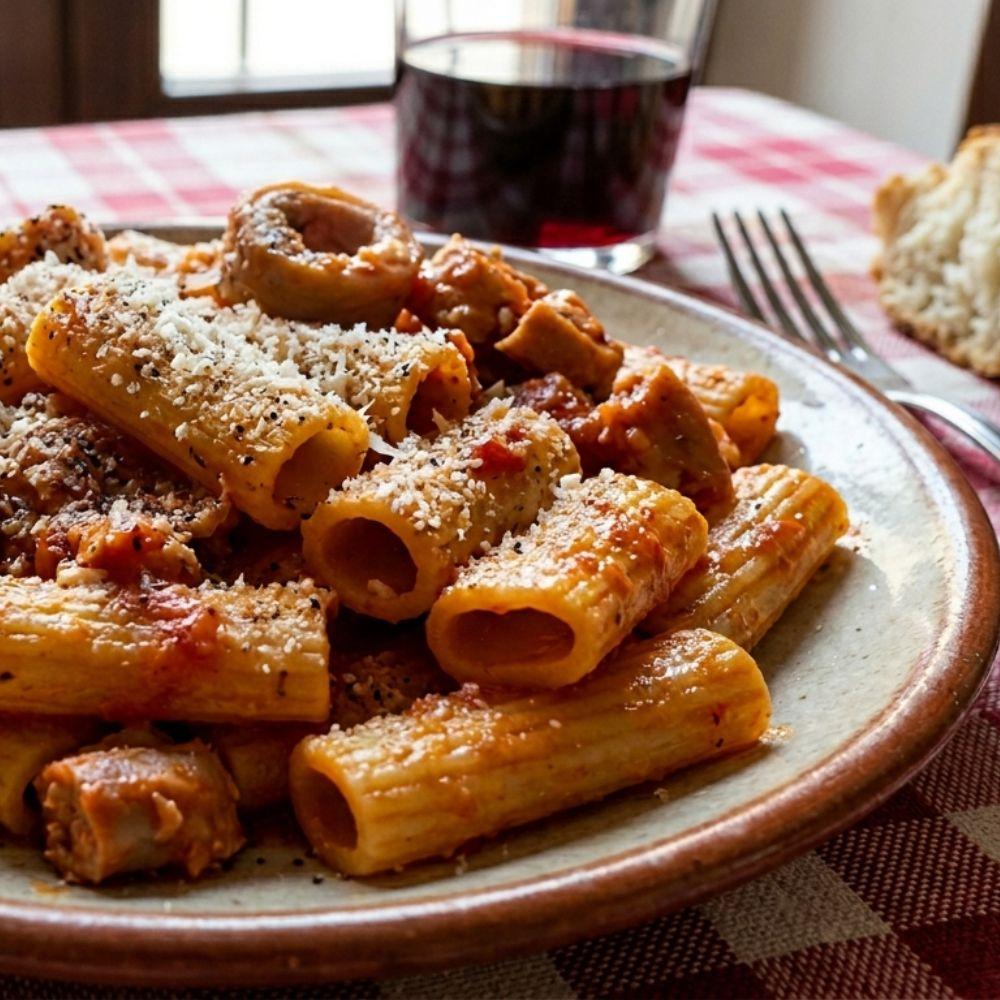
Thick, ridged rigatoni tossed in a slow-cooked tomato ragù built around braised pajata. As the intestines cook, the milk inside coagulates and dissolves into the sauce, creating a creaminess that no butter or cream could replicate. A generous snowfall of Pecorino Romano on top, and you have something that is genuinely greater than the sum of its part. This is cucina povera at its most triumphant.
Pajata Recipe: How it's Traditionally Mde
The intestines are cleaned on the outside, cut into loops, and tied with kitchen twine to keep the filling sealed during cooking. They go into a heavy pot with olive oil, white wine, and tomato sauce built on San Marzano tomatoes, garlic, and dried chili. Low heat, long time: at least an hour, often more. The rigatoni is cooked separately, finished in the pan with the sauce and a heavy hand of Pecorino.
Every step has a reason. This is food with memory, not food with shortcuts.
What Does Pajata Taste Like?
Rich, but not heavy. Savory, with a surprising undercurrent of sweetness.
The coagulated milk inside has a flavor reminiscent of very young cheese - mild, lactic, almost buttery - that blends with the tomato in a way that's genuinely hard to describe and impossible to forget. It's not gamey. It's not extreme. It's complex in the best possible way.
The hesitation people feel beforehand tends to evaporate completely after the first forkful.
What is Pajata Finta?
When authentic pajata was banned during the BSE years, Roman chefs improvised. Pajata finta - "fake pajata" - merged as a workaround, using fresh cheeses or alternative cuts to approximate the texture of the original.
Some versions were clever. But Romans are honest: finta is not pajata, Now that the real thing is back, it's largely a footnote.
Why Pajata is So Controversial
Three reason, essentially.
First, psychology. Most people in the Western world have lot touch with where meat actually comes from. Intestines - with their contents intact - crash directly into that disconnect. The reaction is rarely about flavor. It's about the idea.
Second, the BSE shadow. Even thought pajata has been legal and strictly controlled in Italy since 2015, the memory of the 1990s ban lingers in the back of some diners' minds.
Third, the ethics question. Ironically, pajata sits on both sides of the nose-to-tail debate at once: it's the ultimate expression of using every part of the animal, yet it makes some people uncomfortable for exactly that reason.
In Testaccio, nobody debates any of this. It's just good food.
Discover Rome's Most Authentic Dishes with InRome Cooking
Not convinced by pajata? Completely fair. Rome's food tradition is wide enough for everyone.
Maybe you're more drawn to the silky depth of cacio e pepe, the smoky punch of amatriciana, the quiet perfection of carbonara, or the underrated simplicity of gricia, the pasta locals insist you're not paying enough attention to.
Whatever pulls you in, InRome Cooking will take you there. Our food tours and cooking classes are led by people who didn't study Roman cuisine: they grew up eating it. We'll bring you to the neighborhoods where these dishes were born, and give you the kind of food experience that no restaurant reservation can replicate.
Rome's table is set
Back to top